





 Local Weather
 Weather Forecast
 Weather Warnings
 Weather for Fishermen
 Weather for Marine
 Weather for Aviation
 Weather Monitoring Imagery
 GIS Weather Service
 Tropical Cyclone
 China Weather
 World Weather
 Climate Information Service
 Warnings & Signals Database
 Statistics of Special Weather Events
 Monthly Weather Summary
 Climate Change
 El Nino and La Nina
 Earthquakes
 Tsunamis
 Tide
Tide Geomagnetism
 Space Weather
 Weather Information for Astronomical Observation
 Interactive Sun Path Diagram
 Astronomical Data
 Interesting Astronomical Phenomena
 Time Services
 Calendar
 Almanac
 Real time Radiation level in Hong Kong
 Understanding Radiation
 Radiation Monitoring, Assessment and Protection
 Environmental Radiation Monitoring Programme
 Daya Bay Contingency Plan
 Related Sites
 Schools
 Travel
 Sports
 Outdoor Photography
 CWOS
CWOS Senior Citizens
 Stargazers
 FoOb
FoOb My Little Observatory
 Interactive Map of Storm Damage by Mangkhut
 Educational Resources
 360 Tour of HKO
 Decoding Radiation
 A Tour of Tropical Cyclones
 Cloud Appreciation by Dr Tin
 International Cloud Atlas
 Guided Tour
 Courses and Activities for the Public
 Subscription of e-Bulletins
 Research Forum
 Publications
 International Atomic Energy Agency
 Regional Specialized Meteorological Centre for nowcasting
 Asian Aviation Meteorological Center
 Social Media
 Press Releases
 What's New
 HKO Updates
 LegCo Questions and Answers
 Weather Chit Chat
 Observatory's Blog
 Weather On-Air
 Cool Met Stuff
 Central Briefing
 Tropical Cyclone Report Broadcast
 Observatory's News
 Vacancies
 Tender Notices
 Apps
Apps Personalized Website
 Weather Wizard
 Weather Information in Text
 Weather Information in RSS
 Audio Web Page
 Forms
Forms Open Data
 HKO Corporate Video
 Vision and Mission
 Organizational Structure
 Quality Management
 Hong Kong Observatory – The Facts
 Hong Kong Observatory 2024
 Our Services
 Programme Areas of the Observatory
 History of the Hong Kong Observatory
 Career@HKO
 Visitors Figures
 Hong Kong Observatory Open Day 2025


Why windows shattered by typhoons fall outside the building?
Why Windows Shattered by Typhoons Fall Outside the Building?
Terence Kung
March 2020
Whenever a typhoon hits Hong Kong, there may be news reports about shattered glass windows of buildings from time to time. If you examine them more closely, you may notice that the broken glass windows were not necessarily on the windward side of the buildings. Sometimes you will see glass debris or even air conditioners falling outside of the building (Figure 1). What are the reasons behind?
In fact, the breaking of glass windows during typhoons is mainly due to the following three reasons: (1) impact on the windows by hard windborne debris; (2) the pressure exerted by winds (i.e. wind loading [1]) directly on the windward side of the building exceeds what the glass window can withstand; (3) high winds blow across buildings leading to a difference in air pressure between indoor and outdoor and the glass window cannot withstand the induced force. We may explain the last point with the Bernoulli's principle. The Bernoulli's principle is derived from the law of conservation of energy (i.e. the sum of kinetic energy, potential energy and internal energy must be kept constant). The simple interpretation is: when a fluid (e.g. air) increases in speed of motion and its height remains the same, its pressure will decrease.
There are many applications of the Bernoulli's principle. For example, an aircraft wing is specifically designed in a way that the air flowing over the top surface of the wing moves faster than that below its bottom. According to the Bernoulli's principle, the pressure on the upper surface of the wing will be lower than that from below. This pressure difference results in an upward lifting force (Figure 2), which counteracts the aircraft’s own weight, enabling it to float in the air.
In the city, the distance between the outer walls of some adjacent buildings is relatively small. When air passes through the narrow corridor between them, it will increase in speed due to the wind tunnel effect. According to the Bernoulli's principle, the air pressure in the corridor will thereby fall and the buildings on both sides of the corridor will experience a suction force. This will pull the objects on the surface of the buildings (such as glass or air conditioner) away from the buildings (Figure 3). Even for a single-block building, when high winds blow across it, a positive pressure area will be formed on the windward side of the building due to reduced speed of the airflow. If an opening exists on the windward side of the building (e.g. gaps between windows), positive pressure will also be built up inside the building. Coupled with the pressure difference due to the Bernoulli's principle, an outward force will be exerted to the sides and leeward surface of the building (Please see Figure 4), pulling the objects on the surface of the building away from it.
Therefore whenever a typhoon strikes, you should be cautious about the glass windows of the building even if they are not facing headwinds!
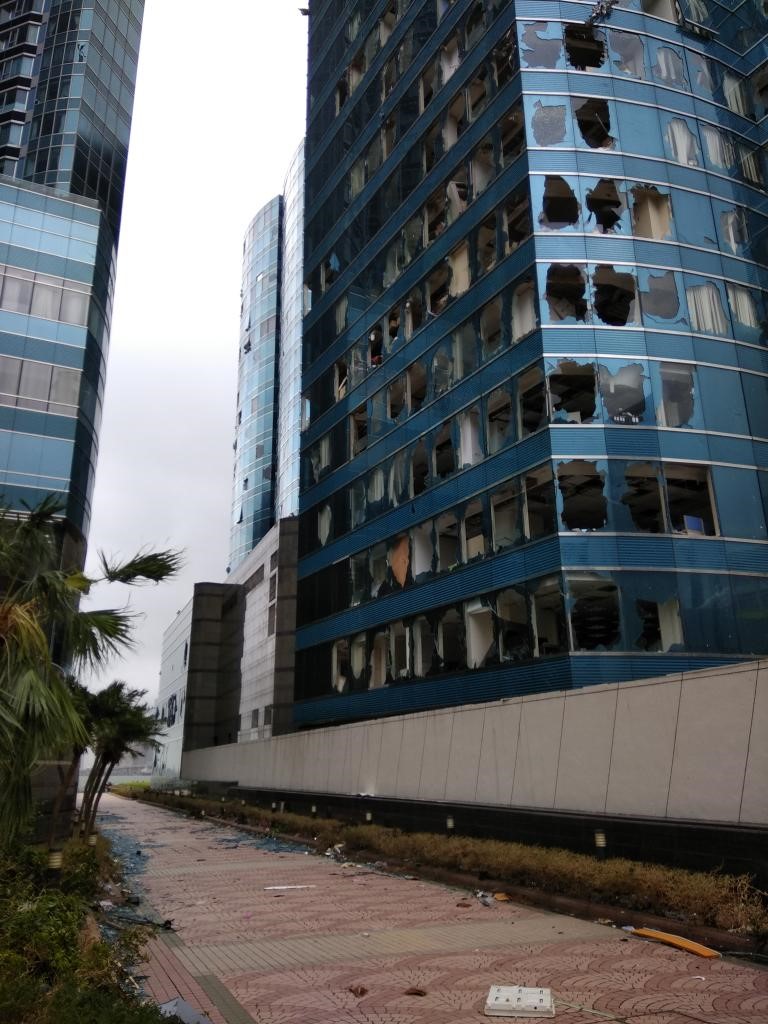
Figure 1. Debris of glass curtain walls falling on the street in parts of the territory when Severe Typhoon Mangkhut struck Hong Kong in 2018 (photo taken by YW Ng in Hung Hom on 16 September 2018).
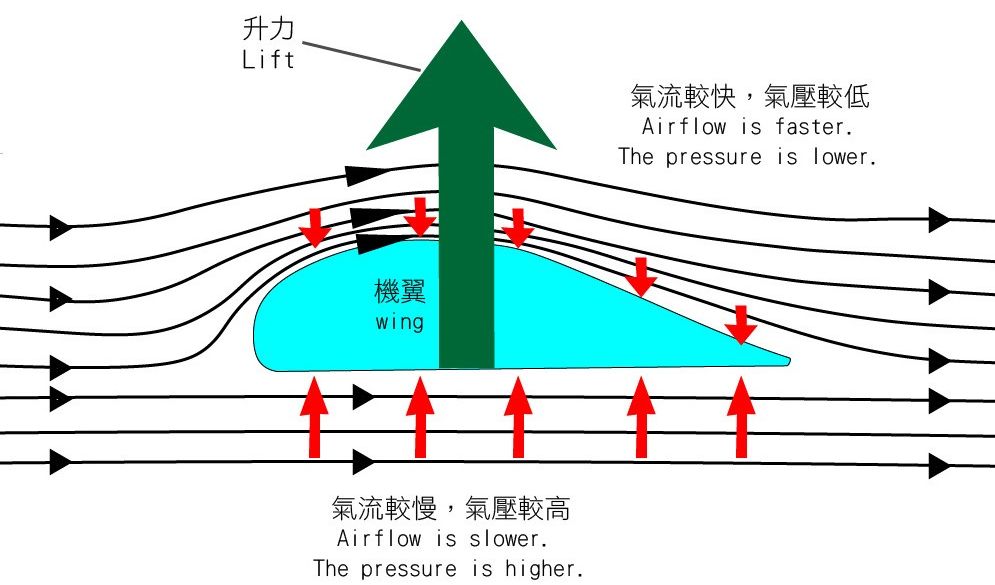
Figure 2. Airflow will be separated when passing through an aircraft wing. The shape of the wing design makes the air flowing over the top faster than the bottom, creating a vertical pressure difference and providing lifting force for the aircraft.
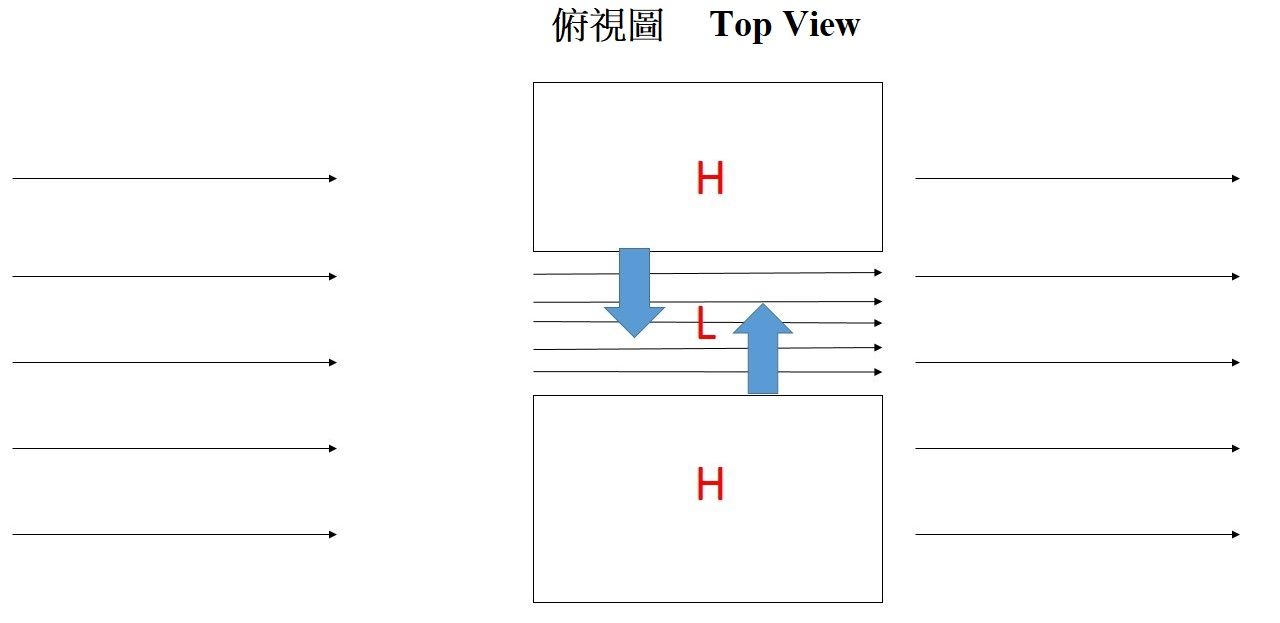
Figure 3. The suction force generated by the wind tunnel effect of the buildings (H represents higher air pressure inside the buildings; L represents lower pressure outside the buildings; black arrows show the direction of air flow, blue arrows show the direction of the suction force).
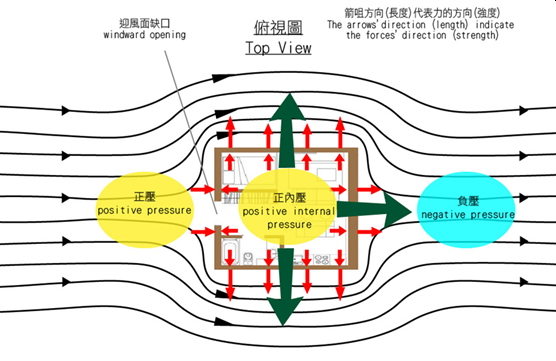
Figure 4. Schematic diagram showing the distribution of pressure at different places inside and outside a building when high winds blow across it. If a gap exists on the windward side of the building, coupled with the pressure difference due to the Bernoulli's principle, an outward force will be formed on the sides and leeward surface of the building.